Flea bite
What it looks like: Small, hard bumps with a distinct red centre point, bright red halo around a darker punctum. Pattern: clusters of three or four, or short irregular groups. Onset: immediately to within an hour. Worst at: within a day. Duration: a few days; the itch can persist for weeks in sensitised people.
Photographs of the bite itself: three photographs of flea bites around the ankles.
| Looks like | small, hard bumps with a distinct red centre point |
|---|---|
| Pattern | clusters of three or four, or short irregular groups |
| Size | 1–8 mm |
| Appears | immediately to within an hour |
| Worst at | within a day |
| Lasts | a few days; the itch can persist for weeks in sensitised people |
| Itch | ●●●●● 5/5 |
| Pain | ●○○○○ 1/5 |
| Usually on | ankles, shins, behind the knees, waistband |
| Active | March to November, any time; fleas live in carpet and bedding and feed opportunistically |
Not sure it is flea? The app reads the photo and names the likeliest cause. Download free iPhone & iPad · no account
How to tell it apart
Fleas jump from floor level, so bites concentrate below the knee — ankles and shins first. The mark is smaller and harder than a mosquito bite and almost always has a visible puncture point in the middle. Clusters of three are common, but unlike bed bugs the grouping is irregular rather than a neat line.
Where and when you meet it
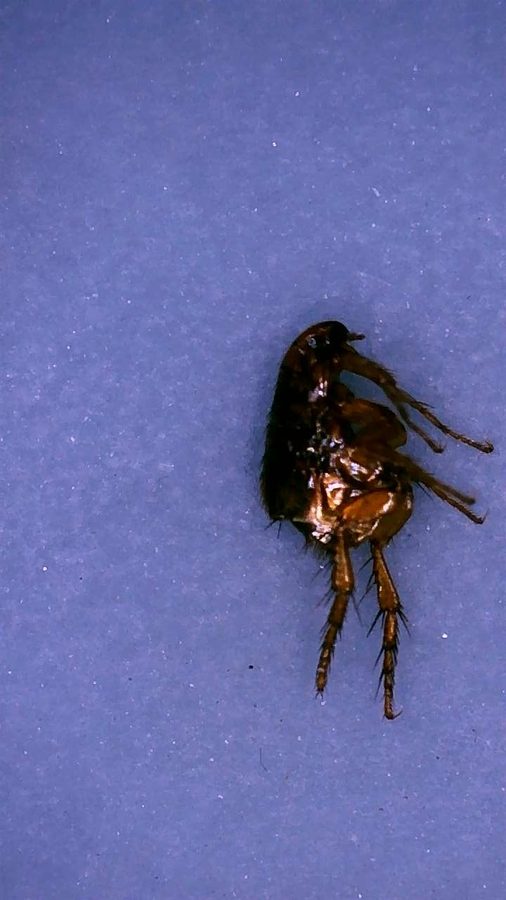
Habitat: pet bedding, carpet pile, skirting boards, upholstery — the adult fleas you see are a small fraction of the eggs and larvae in the floor.
Across 1,734 verified US records in the GBIF biodiversity database, sightings of Ctenocephalides felis concentrate in June, August, September, October. That is the window when bites are most likely — it is observation data rather than a guess, and it shifts with latitude.
States with the most recorded sightings
- Oklahoma 335 records
- California 161 records · all bites in California
- Texas 119 records
- Minnesota 115 records
- Iowa 100 records
- Arkansas 91 records
- Georgia 78 records
- Hawaii 72 records
- Florida 67 records · all bites in Florida
- Illinois 53 records
- Maine 41 records
- Massachusetts 29 records
Record counts reflect where people report and identify specimens, not exact abundance. They are useful for ruling a species in, not for ruling it out.
Where it is recorded
| Country | Records | Peak months there |
|---|---|---|
| United States | 1,734 | October |
| Australia | 519 | January, May, December |
| United Kingdom | 242 | July |
| Canada | 213 | July to August |
| France | 88 | March, August, November, December |
| Brazil | 55 | April, August, September, October |
| Germany | 34 | August, November, December |
Verified records from the GBIF biodiversity database across the seven countries we cover. A country missing from this table means we have no records for it, not that the species is absent.
What it means for you
If bites are below the knee and there is a cat or dog in the house, fleas are the first thing to rule out — including in homes where the pet has "never had fleas", because a single infested visit or a second-hand rug is enough. Bites that continue for weeks after treating the pet usually mean the carpet stage was never dealt with.
Associated illnesses in the US
- murine typhus (Gulf Coast, California, Hawaii)
- cat scratch disease bacteria carried between cats
- flea tapeworm (mainly in children who swallow a flea)
Most bites transmit nothing. What matters is the follow-up: note the date, and report any fever or rash in the following weeks to a clinician along with the fact that you were bitten.
Seek medical care if
- spreading redness and warmth (infection)
- fever with a rash days after bites
- hives or swelling of lips or tongue
Care at home
- wash with soap and water
- cold pack and an antihistamine
- treat the pet and the home on the same day — skin treatment alone changes nothing
Preventing the next one
- year-round veterinary flea control for pets
- vacuum daily during an infestation and empty the canister outside
- wash pet bedding on hot wash weekly
Common questions
Do fleas bite humans?
Fleas jump from floor level, so bites concentrate below the knee — ankles and shins first. The mark is smaller and harder than a mosquito bite and almost always has a visible puncture point in the middle. Clusters of three are common, but unlike bed bugs the grouping is irregular rather than a neat line.
What does a flea bite look like?
Small, hard bumps with a distinct red centre point, bright red halo around a darker punctum. Pattern: clusters of three or four, or short irregular groups. Size: typically 1–8 mm across.
Does a flea bite hurt?
Pain is barely noticeable (1 out of 5 on this site's scale) and itch is intense itch (5 out of 5). Onset: immediately to within an hour. Worst at: within a day. Duration: a few days; the itch can persist for weeks in sensitised people.
How do I know it was a flea?
Fleas jump from floor level, so bites concentrate below the knee — ankles and shins first. The mark is smaller and harder than a mosquito bite and almost always has a visible puncture point in the middle. Clusters of three are common, but unlike bed bugs the grouping is irregular rather than a neat line.
How long does a flea bite last?
Duration: a few days; the itch can persist for weeks in sensitised people. Worst at: within a day.
When is it a problem?
Seek care for: spreading redness and warmth (infection); fever with a rash days after bites; hives or swelling of lips or tongue.
Can it transmit disease?
In the United States this species is associated with murine typhus (Gulf Coast, California, Hawaii), cat scratch disease bacteria carried between cats, flea tapeworm (mainly in children who swallow a flea). Most bites transmit nothing, but symptoms in the weeks after a bite are worth reporting to a clinician.
Get a photo assessment in the app
Everything above is free to read. The app adds what a page cannot: point your camera at the bite and get an assessment of the most likely cause, a severity read, and a day-by-day care plan — including the specific signs that mean you should be seen.
Download on the App Store — free
iPhone and iPad · Free to download · No account needed